
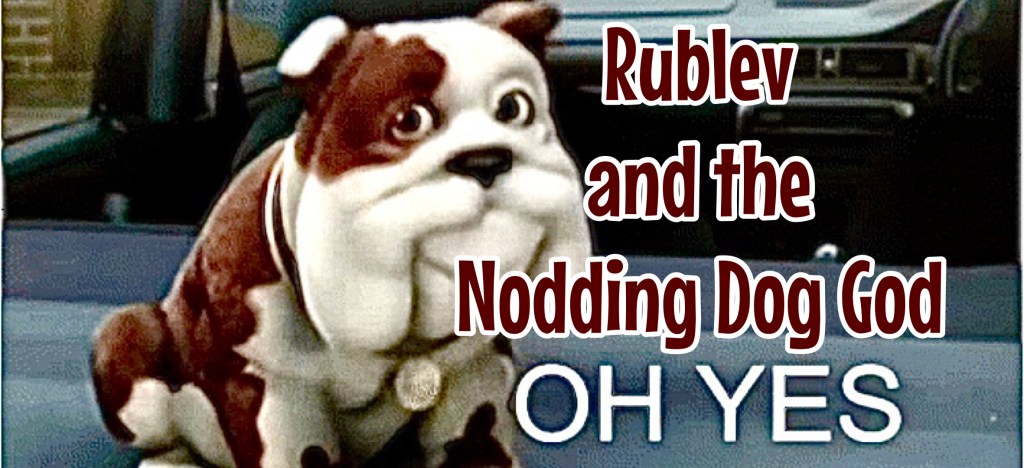
Rublev and the Nodding Dog God
Sermon at St Mary, Newbourne and St Martin, Nacton, Trinity
Sunday – 4 June 2023
Text: The grace of the Lord Jesus Christ, the love of God, and the communion of the Holy Spirit be with all of you. (2 Corinthians 13.13 NRSVA)
God give you peace my Sisters and Brothers.
Every year as Trinity Sunday looms clergy ponder who will draw the short straw when it comes to preaching. It doesn’t seem to matter whether its Year A, B, or C the lections are the Preacher’s equivalent of a Train Smash! It seems as if the authors of the Revised Common Lectionary, determined to tease the doctrine of the Trinity from the words of the Bible, have scoured it’s pages to find any incidence where all three persons of the Godhead are named in the same paragraph and, regardless of context, parcelled them up in some kind of order to hand over to preachers saying, ‘We’ve done our bit now it’s over to you!’
For reasons such as this, the most frequently given advice from Vicars to their Curates about preaching on the Doctrine of the Trinity is the one-word response ‘Don’t!’ Yet here I am…! You would have thought that after nearly 40 years in Holy Orders I might have learnt to dodge this particular bullet. Indeed that was my plan, having rota’d myself off in Felixstowe, only to find that means I am free to be with the good people of the Orwell and Deben Benefice. Hoist on a petard of my own making or what?
But relax. I’m not going to talk about the Trinity and how the various persons in the God head relate to each other. I’m not going to use metaphors about ice, water and steam or how a single person can be child, spouse and parent; usually this will drift into a heresy of one kind or another. Instead I’m going to take a familiar prayer from one of today’s readings which trips easily, perhaps too easily, off our tongues. And ask what it would mean for us to take its words seriously. After what could be more self-explanatory than the words;
The grace of the Lord Jesus Christ, the love of God, and the communion of the Holy Spirit be with all of you. (2 Corinthians 13.13 NRSVA)
Let’s see if this simple prayer is really that ‘simple’.
The Grace of the Lord Jesus Christ
It has become a tradition at the end of some Zoom meetings I attend to close with the host saying, ‘OK everyone before we leave let’s all “unmute” and say the Grace together’. And with a few keystrokes of the computer the story of the Tower of Babel returns! I have a tendency to remain muted!
Mind you, this is slightly better than the well-meant ending to a physical meeting which ends with the saying of the ‘Grace’ by everyone holding hands whilst we smile, pray and nod heads at each other. In doing this we can end up with a passable imitation of Winston the nodding dog from the adverts for Churchill insurance! Perhaps the next time it may be tempting to replace ‘Amen’ with Winston’s catchphrase ‘Oh yes!’?
The Grace of our Lord Jesus Christ is much more than a smiley face or a cacophony of unmuted voices.
The Grace of our Lord Jesus Christ is a touching place, God choosing to come and live amongst us and make our flesh sacred.
The Grace of our Lord Jesus Christ seeks out the rejected and the neglected.
The Grace of our Lord Jesus Christ speaks up for those who have no voice and those whose lives are wracked by the pain of disease and life in a sin-sick world
To pray for ‘The Grace of our Lord Jesus Christ’ is about more than pressing the ‘unmute’ button on a computer or even holding hands, smiling and nodding at those around us who are like us. The Grace of our Lord Jesus Christ call us, just as Jesus did for us, to give ours lives away for others.
Taken seriously the Grace of our Lord Jesus Christ will turn our world upside down and put it the right way up with us at the bottom of the heap as the servants of others alongside our Lord and Master who is servant of all. Now that is something about which to smile and nod our heads at.
The Love of God
The life altering Grace of our Lord Jesus Christ is made possible when we allow ourselves to be immersed in and led by the Love of God. This is not always as easy as it sounds…
I don’t know about others but I don’t find it very easy to be the object of someone else’s affection. It’s not that I don’t appreciate being loved and cherished by others – it’s a very special thing and I weep for those who have no one to watch over them – It’s that I don’t think I deserve love.

Part of this is because I know ‘me’. You know that person inside who is always looking out for themselves, is annoyed when they can’t get their own way, has to bite their tongue every time their routine is disrupted, and wants to scream out Greta Garbo-like ‘I want to be left alone’.
And then in the middle of all this God, who knows everything about the voices within me, who has seen everything I have hidden from others, who knows every thought I have ever ‘thunk’ and, as we have just prayed,
to whom all hearts are open, all desires known, and from whom no secrets are hidden:
…stands next to me and says ‘Andrew, I love you.’
What are we supposed to do with such undeserved love?
How are we to cope with a God who, even from the moment of our first parents disobedience, comes looking for us in the middle of our nakedness and longingly calls ‘Where are you?’
In the face of such love all I can do is surrender, and with the Prodigal son, offer back the rags of my wasted life and say ‘treat me like one of your servants’ (Luke 15v19). And in so doing find myself bowled over by a generous love that clothes me with fine robes and provides a place of honour at the banquet.
George Herbert says it all really;
LOVE bade me welcome; yet my soul drew back,
Guilty of dust and sin.
But quick-eyed Love, observing me grow slack
From my first entrance in,
Drew nearer to me, sweetly questioning
If I lack’d anything.
‘A guest,’ I answer’d, ‘worthy to be here:’
Love said, ‘You shall be he.’
‘I, the unkind, ungrateful? Ah, my dear,
I cannot look on Thee.’
Love took my hand and smiling did reply,
‘Who made the eyes but I?’
‘Truth, Lord; but I have marr’d them: let my shame
Go where it doth deserve.’
‘And know you not,’ says Love, ‘Who bore the blame?’
‘My dear, then I will serve.’
‘You must sit down,’ says Love, ‘and taste my meat.’
So I did sit and eat.

…and having been loved so deeply, so unworthily, how dare we not learn to love ourselves? For it is only as we learn to love ourselves that we will ever find the strength and grace to love others in the same way God loves us. (John 13v34)
And finally we close our small prayer with The Communion of the Holy Spirit.
Some will have wondered if they heard the reading correctly when the word ‘Communion’ instead of ‘Fellowship of the Holy Spirit’ was used. The wording depends on which version of the earliest scriptures are used in the translation we read.
Personally I prefer ‘Communion’ to ‘Fellowship’ as this calls us to align our lives more closely to the intimacy found within the Holy Trinity as seen in Rublev’s famous Icon of the Trinity which has the Godhead eating at a table together.

The Communion of the Holy Spirit reminds us that everyone is welcome at the table of God’s love and generosity.
Communion reminds me of Peter’s vision of the great sheet containing all kinds of food for the feast (Acts 10v9-16). In the economy of the Holy Spirit nothing is unclean and all are welcome to the feast.
This is not easy to do!
Too frequently, when discussing Food Banks I hear the question, which is often a veiled complaint, ‘But do they really need help?’ Or worse, ‘How dare you give food to people who come from Ipswich!’
I’ve never quite worked out what geography has to do with hunger and am always mindful of the dangers of slipping into the Cain Cop-out of ‘Am I my brother’s keeper?’ (Genesis 4v9) which is the saddest of all responses to human need.
But the Communion of the Holy Spirit goes beyond food banks with their stale bread, wilted veg, and dented tins of baked beans to something deeper and more at the heart of our faith. Sharing bread and wine together at the Table of our Lord.
Too many times down the history of our faith people have found reasons to deny others communion.
Too many times the church has turned people away from God’s generosity.
Too many times people have said you can’t eat here because you are a Greek or a Jew or a man or a woman or a slave or a free person – and those exclusions are railed against in the pages of the New Testament!
Then Holy Spirit weeps whenever we exclude people because they are divorced, or born out of wedlock, or an ordained woman, or a married priest, or have a tattoo, or have a different skin colour and speak a different language. And the list goes on and on and on.
Who are we to pray for to be part of ‘the Fellowship of the Holy Spirit’ whilst denying others Communion as part of the Body of Christ?
A Canadian priest friend of mine has this to say to those who exclude others:
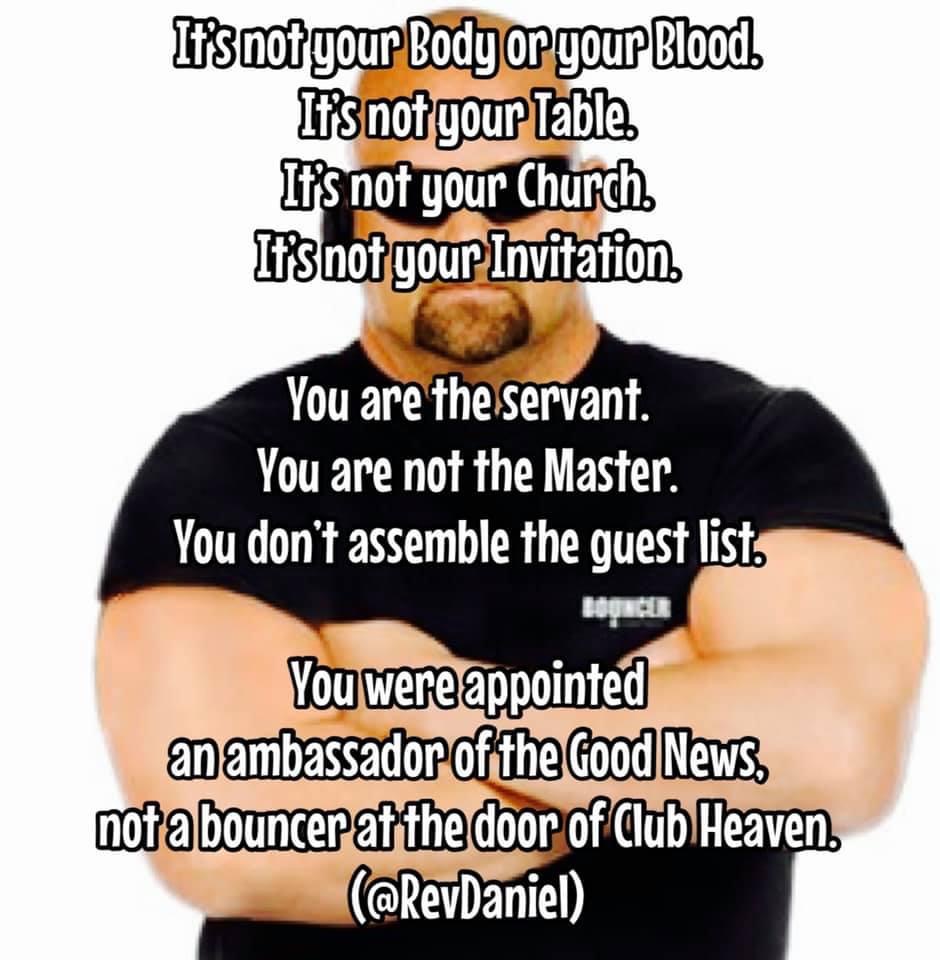
It’s not your Body or your Blood.
It’s not your Table.
It’s not your Church.
It’s not your Invitation.
You are the servant. You are not the Master.
You don’t assemble the guest list.
You were appointed an ambassador of the Good News
not a bouncer at the door of Club Heaven.
(Rev Daniel Brereton)
Ouch!
Next time, be it at the end of a Zoom when everyone is asked to ‘unmute’ or in a meeting where we join hands to nod and smile at each other, may we each take a deep breath before saying these words;
The grace of the Lord Jesus Christ, the love of God, and the fellowship of the Holy Spirit.
And then as we breathe out pray that these will not simply be words said but also a deep commitment to ask that our lives be transformed.
God the Holy Trinity longs to fill us with a grace big enough to reach out and touch the untouchables; a love deep enough to restore our brokenness and that of those around us; and a fellowship wide enough to embrace all people regardless of their sin or circumstance or difference.
Why settle for anything less?
This blog ‘Rublev and the Nodding Dog God’ is copyright © Andrew Dotchin 2023. It may be reproduced free of charge on condition that the source is acknowledged.
 Suffolk Vicar