Cave-In
Sermon at St John The Baptist, Felixstowe – Easter Day – 31 March 2024
Text: they went out and fled from the tomb, for terror and amazement had seized them, and they said nothing to anyone, for they were afraid. (Mark 16v8)
God give you peace my sisters and brothers.
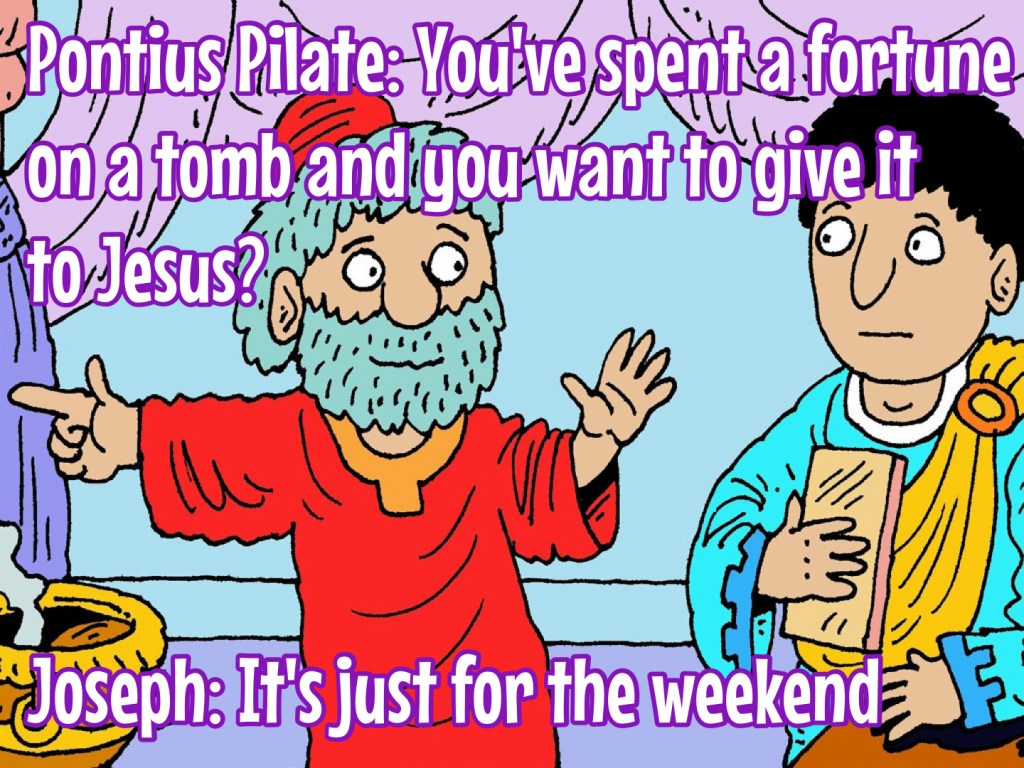
The story is told that, at the end of all the events of Good Friday, Pilate and Joseph of Arimathea sat down for a brew and a catch-up. Reflecting on what had just happened and Joseph’s generosity in giving his own tomb to the wandering preacher from Galilee, Pilate said to him, ‘You must be mad! You’ve spent a fortune on that new tomb only to go and give it away.’ To which Joseph of Arimathea replied, ‘Well, Jesus only needs it for the weekend…’
One of my roles on General Synod is, on behalf of the Church of England, to keep abreast of changing practices around funerals. There are both ancient and modern (sometimes very modern) ways of caring for the dead but the one that I can never quite get my head around is the idea of the cave tomb, or catacombs as they were called in ancient Rome. Perhaps I’ve watched, from behind the sofa with eyes half-closed, too many Hammer Horror movies which always seem to end up in damp dark cobweb-clothed crypts. I can’t quite imagine visiting a subterranean memorial. I like my dead in green covered churchyards or safe in Davy Jones’s Locker. Anything in-between gives me the creeps.
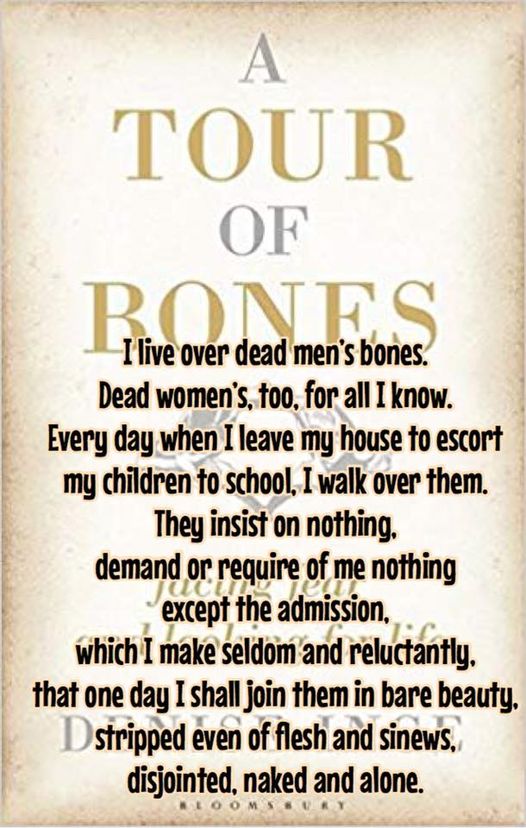
I am not alone in this, Denise Inge, the much-loved late wife of the Bishop of Worcester, discovered that the kitchen in the Bishops’ Palace had a cellar beneath it, and beneath the cellar was a charnel house containing the skulls and bones of generations of monks who (before the Dissolution of the Monasteries) had lived, worshipped, and gone to glory near her home. To cope with her heebie-jeebies she and a friend went on a holiday visiting a whole range of charnel houses. During her pilgrimage she received a diagnosis of a cancer from which she did not recover… Her bones now rest in the same charnel house of which she was frightened. She writes in her book ‘A Tour of Bones’.
I live over dead men’s bones. Dead women’s, too, for all I know. Every day when I leave my house to escort my children to school, I walk over them. They insist on nothing, demand or require of me nothing except the admission, which I make seldom and reluctantly, that one day I shall join them in bare beauty, stripped even of flesh and sinews, disjointed, naked and alone.
(Denise Inge – A Tour of Bones)
For Christians the grave, because of the death and resurrection of our Beloved Redeemer, is not to be a place of despair but it is the bed of hope. We are called to no longer live in fear of death (Hebrews 2v14-15). But Denise and myself are not alone when it comes to our fear of catacombs and charnel houses. Even the women at the garden tomb are frightened; in fact so frightened that they are speechless. But why should they be? After all the Jewish faith has a long tradition of ‘Death Doulas’, (Chevra Kadisha) women at the heart of the community whose calling and gift to their community is to enter tombs and care for the dead. Why should they be afraid?
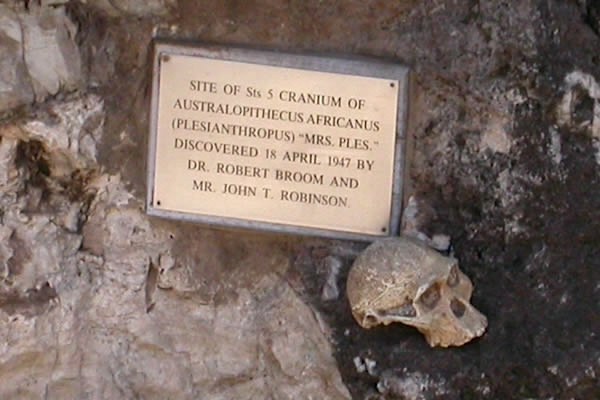
Caves, though dark and dingy and cobwebby can be full of life. In South Africa the pre-historic Sterkfontein caves at Kromdraii near Johannesburg is called ‘The Cradle of Humankind’. It is there that the fossils of the earliest Hominids were found. For our pre-historic ancestors caves were places of sanctuary. Caves provided protection from the extremes of weather and the assaults of the sabre-toothed tiger. In these places the history of their lives was daubed on the walls and these caves became their sanctuary; not a place of fear. Some Biblical translators say that Mary gave birth to Jesus not in a stable, (something unknown in that era), but in a cave under the Inn; not a place of fear. And today we find Jesus born anew, not in a cave but in a catacomb; not a place of fear but a place of joy and hope!
Why then were the women, so used to working with and caring for the dead, frightened and silent?
A key lies in discovering to whom Mark is telling his story. When we listen to a radio broadcast we listen differently when different words are spoken. If a programme begin with, ‘Hello children, I want to tell you a story’ while another begins with, ‘This is the BBC’ we will listen differently. The first will prepare us to listen to tales of Winnie the Pooh and the 100 Aker Wood, the second prepares us to listen to important events from around the world. ‘How’ and ‘why’ someone tells their story is as important as the words of the story itself
This is true of the Bible. We should not be surprised that the same story is told in different ways. The people to whom Mark is telling the old old story of Jesus and His love informs how the story is told. So who and where are they when they hear his words? We know Mark’s is the earliest of the Gospel and that it was written from around the year 60 CE. It was at this time that the first persecutions of Christians by Roman authorities had begun. Christians were forced to meet in secret for fear not only of the Jews but of the Romans as well! Where could they meet where they would not be pursued? In the catacombs, down amongst the dead. Places full of fear for those who did not believe in the Resurrection but a place of hope for the followers of the way of the Lord. And it was there, surrounded by the dead and in fear of being killed themselves that they heard the news of the hope that was born in a cave in Bethlehem and escaped from a tomb in Jerusalem.
These frightened cave-dwellers, hearing the Good News that comes to them from beyond the grave, are given a choice. When they venture out from the catacombs do they live in fear and keep quiet about our Resurrected Redeemer, as did the women in Mark’s Gospel. Or do they leave the place of death to proclaim the Gospel of Life?
And now this Easter Day it is our turn. When we venture out from this place of sanctuary, this place of safety where all are welcome and none are condemned. Will we be like the Death Doulas of Mark’s gospel? Will we keep quiet for fear that someone may find out about the hope that lives within us or will we proclaim an everlasting hope to a sin-sick world?
At the end of my words five of our number, of their own choice will proclaim;
I turn to Christ.
I repent of my sins.
I renounce evil.
As they are baptised into the fellowship of Christ’s religion, we who have been baptised perhaps a long time ago, are called stand with them and go from this place to live lives transformed by the Good News in which fear is banished and hope calls us homeward.
This blog ‘Cave-In’ is copyright © Andrew Dotchin 2024. It may be reproduced free of charge on condition that the source is acknowledged.
Mark 16.1-8
When the Sabbath was over, Mary Magdalene and Mary the mother of James and Salome bought spices, so that they might go and anoint him. 2 And very early on the first day of the week, when the sun had risen, they went to the tomb. 3 They had been saying to one another, “Who will roll away the stone for us from the entrance to the tomb?” 4 When they looked up, they saw that the stone, which was very large, had already been rolled back. 5 As they entered the tomb, they saw a young man dressed in a white robe sitting on the right side, and they were alarmed. 6 But he said to them, “Do not be alarmed; you are looking for Jesus of Nazareth, who was crucified. He has been raised; he is not here. Look, there is the place they laid him. 7 But go, tell his disciples and Peter that he is going ahead of you to Galilee; there you will see him, just as he told you.” 8 So they went out and fled from the tomb, for terror and amazement had seized them, and they said nothing to anyone, for they were afraid.
 Suffolk Vicar