
Eat Me – Feasting with Jesus
Sermon for 10th Sunday of the Year – 8th August 2021 – St John the Baptist, Felixstowe
Text: [Jesus said] ‘Unless you eat the flesh of the Son of Man and drink his blood, you have no life in you.’ (John 6v53)
God give you peace my Sisters and Brothers.
(Read Text aloud)
Early this week, when I first looked at today’s gospel reading three things entered my mind:
If we do indeed ‘have no life’ unless we ‘eat the flesh of the Son of Man’ does this mean that;
- Members of the Salvation Army, who do not have any common worship involving bread of any sort, cannot go to heaven? That is a nonsense so Jesus can’t be speaking just about bread and wine.
- If the church excommunicates someone does that cast them out of Paradise forever? (…and if that is the case how dare we ever excommunicate anyone and take the place of God as judge and jury of our own family members!).
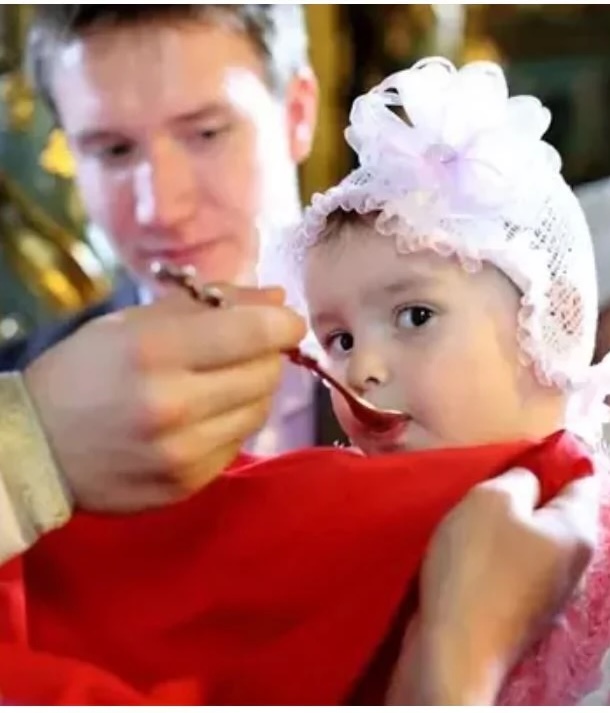
- Can we bar anyone, even children, from receiving communion? My argument, and this is what happened with our own children is ‘no!’ This view is strengthened by the tradition of giving a child a spoon, preferably silver, at their baptism. It is not intended to be used with a dippy-egg but historically was a communion spoon. …and this is the practice in Orthodox Churches to this day.
Feasting with Jesus is about much more than rules about wine or grape juice, bread or wafers.
It is not about who is ‘in’ and who is ‘out’.
And it is definitely not about weighing someone’s comprehension of sacramental theology against their use of the sacraments. After all a child doesn’t need to understand about the five basic food groups before their mother nurses them.
Neither do we need to know the finer points of eucharistic theology before we approach the communion rail.
Feasting with Jesus
Flora Winfield, a friend and recently appointed as Bishop of Selby in the Diocese of York, reminds us of the all-encompassing nature of our faith when she says;
‘Every table is a table where Christ is present as host and guest and feast.’

The key to our spiritual diet, just as it is for our physical diet, is found in what we eat. As the dieter’s fridge magnet says, ‘You eat it, you wear it.’ Looking for nourishment to help us grow up good we hear Jesus say:
I am the living bread that came down from heaven. Whoever eats of this bread will live for ever; and the bread that I will give for the life of the world is my flesh.’ (John 6v51)
In Him we find all the nourishment we need to become the Body of Christ. And if we can learn to do this correctly then ‘You eat it, you wear it’ can become a mantra for holiness.
Jesus’ words about being the Bread of Life and ‘consuming’ Him (though often read to be so) are not about Holy Communion. They are much deeper than that……
Firstly, Jesus is not speaking about bread but about God’s provision.
When he compares the gift of His very self to those who would follow Him in the same way as his accusers describe the ‘manna which came down from heaven in the desert’, Jesus is calling us to look beyond satisfying the needs of the body to the feeding of our lives. The Bread of Life is God’s gift to enable us to journey towards the Promised Land and as such is to be consumed day by day in faith, hope, and the sure and certain knowledge that we are indeed God’s children who are cherished, protected, and provided for daily.
Secondly, Jesus is not speaking about food but about nourishment.
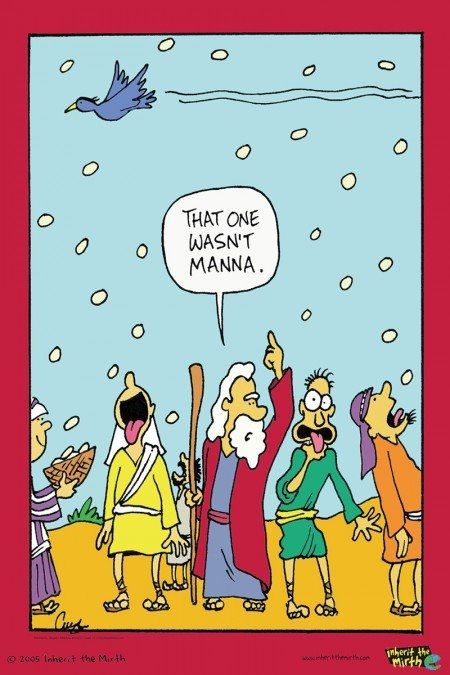
He reminds us that depending on manna alone leads to death and decay:
Your ancestors ate the manna in the wilderness, and they died.
The story of Exodus tells us that none of those who left Egypt entered the Promised Land. If we come to Jesus to feed ourselves alone, we too will find it difficult to cross the Jordan into the land flowing with Milk and Honey. To partake of the Bread of Life is not so much about filling our tummies but strengthening our souls. Jesus is God’s gift to enable us to grow up good and we must seek daily opportunities to be nourished by Him.
Finally, Jesus is not speaking about Body (corpus) but about Being (sarx).
Jesus, when describing himself as ‘The Bread of Life’ does not use the Greek word for body (corpus) but the one which describes our very being (sarx) – translated in the Bible as ‘flesh’. This is crucial. Too often Christians have confused the two. So, when St Paul speaks about ‘the sins of the flesh’ we easily think it is about the bad things we do with our bodies when in fact ‘the sins of the flesh’ are not about deeds but thoughts, not about our actions but about our mindset.
When we come to Jesus to consume the Bread of Life, we are not in fact eating bread at all, but are consuming all that Jesus is and calls us to be in the fervent hope that we, too often prisoners of our ‘flesh’ are transformed.
When Jesus says, ‘Eat Me’, He calls us not to observe the particularities of ritual and doctrine but to become the Body of Christ and grow into the image and likeness of God that was marred by our first parents in Paradise.
When we receive Communion, we use the words ‘The Body of Christ’. These words are, at the same time, a statement, a question, and a greeting.
It is a statement – Jesus tells us that when we gather to break bread in memory of Him, He is always present with us.
It is a question – When we say ‘Amen’ to the question ‘The Body of Christ?’ asked by the Minister we are challenges to acknowledge the reality of the sacrament. Every ‘Amen’ we make is our decision to answer again the questions asked of us at our baptism.
It is a greeting – committed to growing up good, when we come forward to receive communion, the words ‘The Body of Christ’ refer not only to the sacrament but to us. Our ‘Amen’ is our commitment to not only feed on bread but to grow to become who we are, Christ’s own Body. For this reason I sometimes use this declaration at the communion rail, ‘Receive what you are, the Body of Christ’.
Today, when we receive communion, let us proclaim boldly ‘Amen’ with gratitude, joy, and a determination to become little Christs (one of the meanings of the word Christian) and give ourselves to be food for a sad, lonely, sin-sick, and hungry world.

[This blog ‘Eat Me – Feasting with Jesus’ is copyright © Andrew Dotchin 2024 and may be reproduced without charge on condition that the source is acknowledged. This is an edited version of words previously used on 8th August 2021]
The Living Bread John 6.51–58 [NRSV]
I am the living bread that came down from heaven. Whoever eats of this bread will live for ever; and the bread that I will give for the life of the world is my flesh.’
52 The Jews then disputed among themselves, saying, ‘How can this man give us his flesh to eat?’ 53So Jesus said to them, ‘Very truly, I tell you, unless you eat the flesh of the Son of Man and drink his blood, you have no life in you. 54Those who eat my flesh and drink my blood have eternal life, and I will raise them up on the last day; 55for my flesh is true food and my blood is true drink. 56Those who eat my flesh and drink my blood abide in me, and I in them. 57Just as the living Father sent me, and I live because of the Father, so whoever eats me will live because of me.58This is the bread that came down from heaven, not like that which your ancestors ate, and they died. But the one who eats this bread will live for ever.’
 Suffolk Vicar