Wonder Working Waiters
Sermon for Second Sunday of Epiphany – 18 January 2025 – All Saints, Kesgrave
Text: His mother said to the servants, ‘Do whatever he tells you.’ (John 2v5)
God give you peace my Sisters and Brothers.
Who put salt in the sugar bowl?
Who put fireworks in the coal?
Who put a real live toad in the hole?
My brother
Who put jam in mother’s shoe?
Who made real caterpillars stew?
Who locked granddad in the loo?
My brother
Following on from Terry Scott’s famous moan about his brother we turn to today’s Gospel reading and ask, ‘Who turned water into wine?’
Not Jesus.
Not the Groom (who may have wished he could have).
Not the Master of the Banquet.
It was the servants.
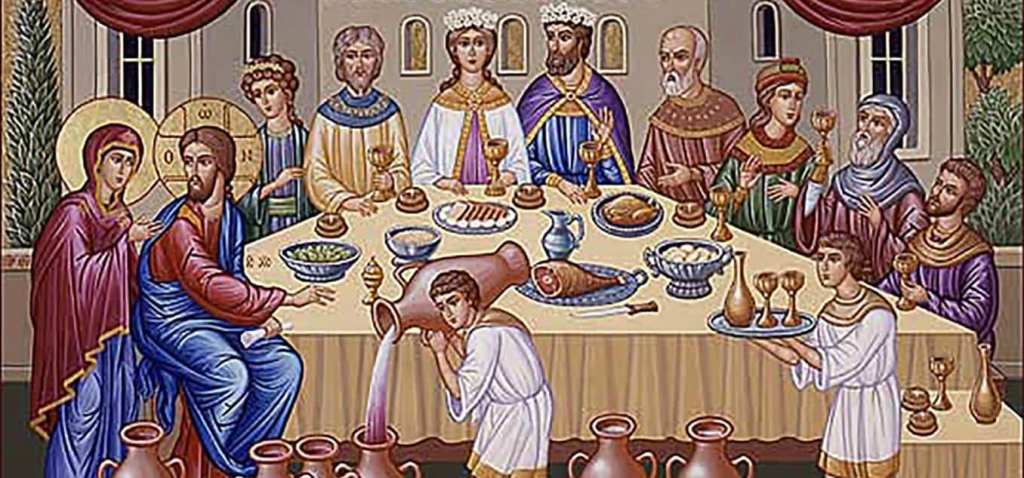
Look at the traditional icon of the wedding at the top of this page.
Where is Jesus sitting? Not at the head of the table, or even at the table near the parents of the Bride and Groom, but on the edge to one side. Even the master of the banquet, the one raising a toast to the Groom, is higher up the table than Jesus. Jesus is on the edge of the feast, most likely listed as his mother’s ‘Plus One’ (Joseph has not been present in the Gospel story since Jesus was 12 years old.[1]) The centre of the table is for the newly wed couple. After all they are the reason for the feast.
But who is at the centre of the Icon? Not Jesus, not Mary, not the couple, but the servants. These are the ones working the miracle. Debbie at the Bell, in fact any pub landlady, would probably give her eye teeth for barmaids like the servants at the Wedding at Cana of Galilee.
Yes, I know the iconographer shows Jesus waving his hand over the water jars but the bible text doesn’t say He did any such thing. All that happened was that the servants did what Mary told them to do; which was to do what Jesus told them to do.
They had turned from being frightened of being fired because they had got the catering numbers wrong, to being the saviours of the feast. I really hope that at the next wedding they catered for the Groom insisted that he would only pay for ‘six stone water jars, each holding from eighty to a hundred and twenty litres, used by the Jews for ceremonial washing…’
Putting aside these ‘Wonder Working Waiters’ for the moment, why was it so important that there was even more wine at a feast that had been going on for three days already? Surely, as implied by the banquet master, the guests had already drunk enough? Why, bearing in mind that John’s Gospel only chooses seven miracles (more correctly called Signs) does a lack of wine at the end of a three-day feast even get a mention?

Cast your minds back to almost the end of the Exodus and the story of Joshua and his friends sent by Moses to spy out the Promised Land. They did indeed find a land flowing with milk and honey and grapes so big that it took the strength of two men to carry one cluster on a wooden pole between them (Numbers 12v33). A symbol used by the Israeli Tourist Board to this day. [Please do increase your prayers for a permanent peace in the Land of the Prince of Peace at this time].
To have wine was a sign of God’s blessing and protection. But for the wine to have run out, and that at a moment of new beginnings, at a wedding, was a disaster! Mary whispering to her Son ‘They have no more wine’ was not a polite request for Him to do something as a guest but a ‘cri de cœur’ for the future of a family and their community.
Looking around at our world, our nation, our community, our parish, have we ever wondered if we are in the same place as those newly-weds? Looking forward to a future but worried that it might be empty? Are we, along with the mother of Jesus saying to God, ‘We have no more wine’.

There are many reasons why we may feel emptied out and alone. At the end of the second World War the French philosopher Paul Valèry said L’avenir n’est plus ce qu’il étaitwhich USA Baseball coach Yogi Berra translated as, the future ain’t what it used to be.
Things are different. Life is not as simple as it used to be. We can’t go back to the old ways because they have vanished and have been thrown away like an empty wine bottle.
Things are also different because we have changed. It’s not just the future it’s us as well. We ‘ain’t what we used to be!’. And in our helplessness we have lost hope, the wine jug is empty and we think the party is over.
Or is it…
This is where we return to faithful fearful servants becoming Wonder Working Waiters at the centre of our Icon. Jesus, and this is his way of working throughout the scriptures, doesn’t choose the powerful and capable to manifest his glory. He chooses corrupt tax collectors, penitent publicans, simple soldiers who are ‘only following orders’, women about whom your mother warned you, failed fisherfolk, and even us to be the workers of miracles that will transform a worn-out world into a feast overflowing with the finest of wine.
How does He do this? The same way now as He did then? Listen again to Mary’s words to the anxious servants; ‘Do whatever he tells you.’ (John 2v5)
And when they do the party begins and the new life, which is the hope of every bride and groom, begins.
It’s quite simple really.
Make space to listen to His voice
Decide to work His works.
Which will also mean we have to stop giving space to listen to other voices, often the most persistent of which may be our own. And we will have to stop doing those things which are not godly, and again many of which serve our self-interest.
Across our Benefice several people are beginning to learn this lesson. The Ministry Team spent a day with the Bishops learning about the Gospel of Luke to inform our preaching this year. One of us is in training to be a Reader and others have offered themselves for licensed ministry. The Angel Festival brought together a whole group of people who listened to God and acted. A small group are learning about personal evangelism with Envoy. Many will be attending the Growing Younger Conference in March and some have also signed up for the Leading Your Church into Growth course in June. Added to this Gary and I are on an intensive year-long course of Ministry Development. (P.S. please speak to a member of the Ministry Team if you want to join any of these events)
The invitation has been given.
Some have heard and are beginning to work wonders.
But this is not a task for those at the front wearing funny robes alone. Remember Jesus uses only the least capable to do His biggest miracles.
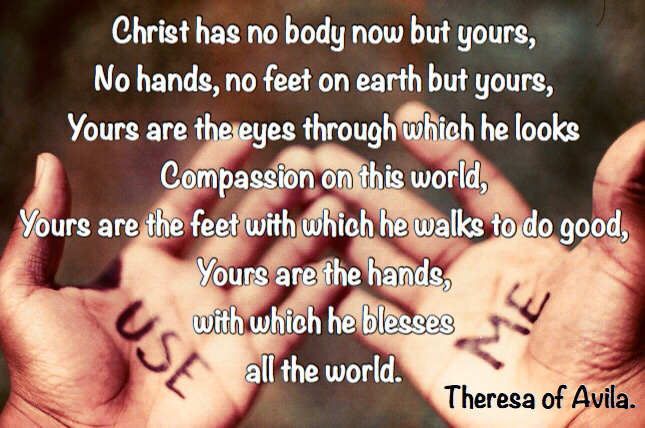
May these words of Teresa of Ávila become our daily prayer:
Christ has no body but yours, No hands, no feet on earth but yours.
Yours are the eyes through which he looks compassion on this world.
Yours are the feet with which he walks to do good.
Yours are the hands, with which he blesses all the world.
Yours are the hands. Yours are the feet.
Yours are the eyes. You are his body.
Amen.
[This blog ‘Wonder Working Waiters’ is copyright © Andrew Dotchin 2025 and may be reproduced without charge on condition that the source is acknowledged.]
oooOOOooo
Jesus Changes Water into Wine
On the third day a wedding took place at Cana in Galilee. Jesus’ mother was there, 2 and Jesus and his disciples had also been invited to the wedding. 3 When the wine was gone, Jesus’ mother said to him, ‘They have no more wine.’
4 ‘Woman, why do you involve me?’ Jesus replied. ‘My hour has not yet come.’
5 His mother said to the servants, ‘Do whatever he tells you.’
6 Nearby stood six stone water jars, the kind used by the Jews for ceremonial washing, each holding from eighty to a hundred and twenty litres.
7 Jesus said to the servants, ‘Fill the jars with water’; so they filled them to the brim.
8 Then he told them, ‘Now draw some out and take it to the master of the banquet.’
They did so, 9 and the master of the banquet tasted the water that had been turned into wine. He did not realise where it had come from, though the servants who had drawn the water knew. Then he called the bridegroom aside 10 and said, ‘Everyone brings out the choice wine first and then the cheaper wine after the guests have had too much to drink; but you have saved the best till now.’
11 What Jesus did here in Cana of Galilee was the first of the signs through which he revealed his glory; and his disciples believed in him. (John 2v1-11)
 Suffolk Vicar