
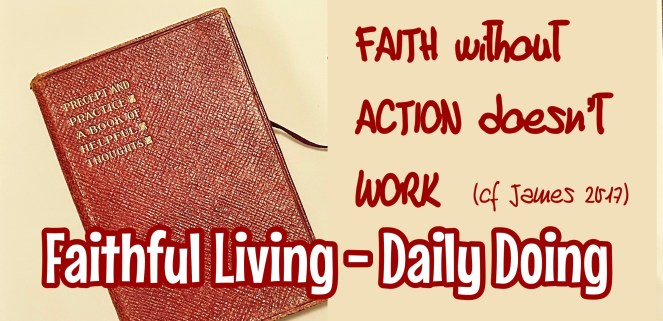
Precept & Practice – FEBRUARY 1 – Duty
It is hardly possible to exaggerate the difference between duty as we dream of it, and duty as we are called to do it. We ever dream of a duty the doing of which shall bring its own reward in satisfying our imagination with a sort of sense of our own excellence. We find it ever so mixed up with draw-backs, difficulties, shortcomings of our own, that we are half ashamed of it when we have done it. We cannot, we cannot bring ourselves to believe the fundamental truth of all morals and all religion which is expressed in the proverb, ‘He that ruleth his own spirit is better than he that taketh a city.’
We dream of duty as just difficult enough to require a real exertion, and then fine and glorious in the show. We find it so difficult as to tax our utmost strength of will, and it looks poor when it is done. We feel as if our strength had ever to be spent on the wrong thing. That which tries us is the strong power of some secret temptation, whose victory over us is a misery, but whose defeat, if we can defeat it, gives us no credit; nay, perhaps, is such that we care not to confess it to a single soul. We always dream of duty in one set of circumstances. We always have to do it in another. And it is in preferring these dreams of ours to the reality that we are betrayed into the mistake of assigning our sins to the circumstances of our life. Cease to indulge in vain dreams of what might have been, and see what duty really is. Our Master, Christ, has given you this thing to do: say not that you are ready to do something else, but not this; say not that this is just what you cannot do; say not that you are but a mere peg in a machine and have no power to move.
All this is either sloth or sheer blindness. Here, as things are, with the help within your reach, you can win your victory. And what is more, however little it may seem so now, you shall one day see that the victory was worth the winning.
Archbishop Temple
oooOOOooo
From the Introduction to Precept and Practice
The kindly welcome given to my other little books, ‘Being and Doing’ and ‘Character and Conduct,’ must be my excuse for adding another collection of extracts to the number now in circulation.
The quotations are gathered from the books of many earnest thinkers, and deal with Life in all its length and breadth, with ourselves, our characters, our plain unvarnished faults and weaknesses, our often untoward circumstances, and with all that drags us down;- with our purposes, our religion, our love and friendships, and with all that uplifts us;- with our relation to others, our influence and responsibilities, and finally with those stages of our journey which bring us to the Road’s Last Turn and to the Silent Land.
CONSTANCE M. WHISHAW
 Suffolk Vicar