

No Guts, No Glory; Turning Disaster into Destiny
Sermon for Easter 5 – Sunday 18 May 2025 – St Mary, Playford
Text: When [Judas] was gone, Jesus said, ‘Now the Son of Man is glorified and God is glorified in him. 32 If God is glorified in him, God will glorify the Son in himself, and will glorify him at once. ( John 13v31-32)
God give you peace my sisters and brothers.
Betrayal, grassing up, let-down, unfaithful, and treachery all describe various levels of disappointment (often after an intentional act) by someone on whom you thought you could depend.
For those who have experienced any of the above the consequences vary from the mild ‘I suspected as much would happen’ to absolute and utter devastation. It is never a pleasant thing to find someone going against what they had promised, and it is very rare that anything good comes from it.
We may say that ‘It’s an ill wind that blows no one any good’, but my experience has been that all I can do against its stormy blast is to turn up my collar and weep bitter tears.
The word ‘Betrayer’ has been one often chosen to describe Judas who, pantomime villain like, slopes out of the Last Supper to receive his ill-gotten thirty pieces of silver. And surely he has earnt his epithet? As the first words of the gospel were read today perhaps it should have been accompanied by a chorus of ‘boos’ and ‘hisses’ from the congregation?
But Judas exit is quickly followed by something unexpected.
When [Judas] was gone, Jesus said, ‘Now the Son of Man is glorified and God is glorified in him’. (John 13v31)

Glory? What is glorious about betrayal? The last response we would expect from the actions of Judas is some sort of divine fist bump and Jesus crying out ‘Yes!’ But that seems to be what he is doing.
Faced with his betrayal, arrest, mock trial, brutal beating, and bloody death, Jesus lets out a whoop of joy and says to the forces of darkness ‘Bring it on!’ This moment of betrayal becomes a cause for glory and the turning away of a friend leads to the proclamation of a New Commandment calling us to a love made visible in deeds.
Can there be glory in despair?
Can a bad thing have a good outcome?
Could it be possible that Jesus was looking forward to his horrible death?
Sitting this side of Easter we know ‘all’s well that ends well’ and that, A-Team like, ‘a plan has come together’ but glory? The cross, even after the resurrection, is surely far too full of gore to be considered as even remotely glorious?
But the promise of glory on, and not just ‘in’, the cross is a key part of how John reveals God’s love to us.
In John’s telling of the Passion story, unlike the other three gospels, the cross is not a place of despair and weeping.
The cross is not a scene of grief-shrouded disaster.
For John the cross is the throne of Christ.
Jesus is not some hapless victim nailed down by the vengeful on a dark Friday Noon. Jesus is the Christ ascending his throne deliberately, willingly and lovingly.
It is not the end of the ‘old old, story of Jesus and his love’ but instead it is the place where the new commandment to ‘love one another as I have loved you.’ Is made manifest!
For this reason early representations of the cross in Christian art were neither the suffering figure on a crucifix, nor the bare empty cross of those who see Good Friday through Easter eyes, but instead the Christus Rex. A cross on which Christ appears, arms outstretched in blessing, wearing royal robes, and instead of thorns, a King’s crown graces his head.

We do not have a Christus Rex in any of our churches, (perhaps a task for the vicar may be to acquire one or three the next time he is chasing his hang-gliding son around Southern Europe…)
But we may ask how is it possible to turn the gore of the cross into the glory of God? God’s plan may be to, in Christ, turn an instrument of torture into the throne of heaven but we are frail human beings for whom this can seem to be a counsel of perfection.
Some of the early followers could and laughed at the martyrdoms they endured. Here the words of one of them;
God forbid that I should glory, save in the cross of our Lord Jesus Christ, by whom the world is crucified unto me, and I unto the world. (Galatians 6v14)
But we? We find ourselves, sadly, more often kinsfolk of Judas and the other failed disciples than our martyred forebears
If only we too could turn betrayal into glory and disaster into destiny.
Jesus faces down betrayal, turns it into glory, and provides an opportunity to proclaim a new love.
Knowing that it is at this very moment that his death is sealed, Jesus tells us how to live a new life by loving in a different way.
No longer are we called to love so that we can earn God’s approval.
No longer is our love to be measured by obeying a legal code or following of ritual
From now on we show our love by our deeds.
Not just ordinary deeds, but deeds done in imitation of the way we have been loved.
As I have loved you, so you must love one another…
We are called to answer betrayal with complete and utter self-sacrifice.
We are to learn to give ourselves away out of love for those whose only aim is to turn us in to the authorities.
Refusing to let the one who has fallen off of the edge of our fellowship be cast out into darkness, we reach out to them and bring them home.
After all Judas also had his feet washed by Jesus? And Jesus gave him bread to eat, the very same bread we will receive at the communion rail this morning. Communion has never been reserved for the holy alone. It has always been, since that first supper in an Upper Room, given to those who, like you and I, mess up and get things wrong.
Can we show such love?
Can we care even for those who have been to us as Judas was to Jesus.
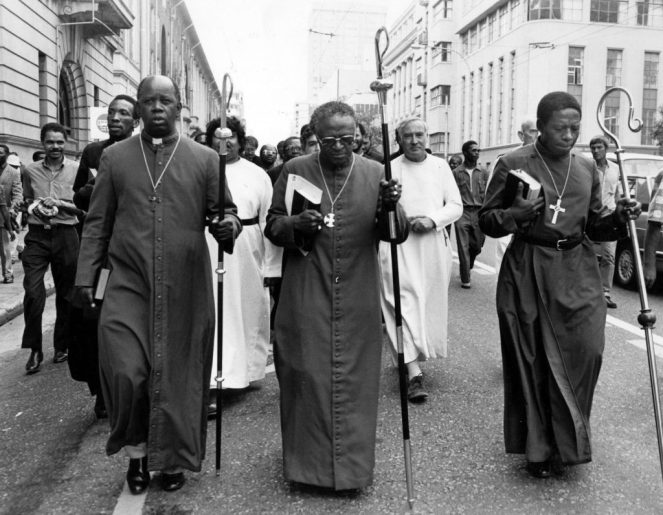
I’m not sure I always can, and I speak as someone who, with my beloved friend Desmond Tutu, handed ourselves over to the police at John Vorster Square in Johannesburg for the ‘crime’ of loving others regardless of race, religion or skin colour.
But if I can’t forgive those who betray me how can I expect forgiveness from God?
As I have loved you, so you must love one another….
We must needs find a deeper love to help us for those times when others betray us.
A love which will restore us when we find that we are the ones who have betrayed our Beloved.
A love that finds hope in failure and glory in weakness.
Perhaps Jesus could see glory in the betrayal of Judas because he knew that the Father’s love is deepest in the darkest places?
And knowing this instead of seeing the cross as a place of shame and suffering turned it into a throne from which to proclaim a new love, a new commandment.
‘A new command I give you: love one another. As I have loved you, so you must love one another. 35 By this everyone will know that you are my disciples, if you love one another.’ (John 13v34-35)
Our love for God is not measured by our devotion to God.
Our love for God, as was the Son’s love, is measured by how we love the unlovely, the unfaithful, and even the traitor.
For each of us knows that we also have been unloving, unfaithful, and our hearts have betrayed us,
Yet, having wounded God we are still loved by God.
How can we not love those who have wounded us?
By this everyone will know that you are my disciples, if you have love for one another.’ (John 13v34-35)
[This blog ‘No Guts, No Glory’ is copyright © Andrew Dotchin 2025 and is an adapted version of words from May 2019]
oooOOOooo
John 13v31-35
When [Judas] was gone, Jesus said, ‘Now the Son of Man is glorified and God is glorified in him. 32 If God is glorified in him, God will glorify the Son in himself, and will glorify him at once.
33 ‘My children, I will be with you only a little longer. You will look for me, and just as I told the Jews, so I tell you now: where I am going, you cannot come.
34 ‘A new command I give you: love one another. As I have loved you, so you must love one another. 35 By this everyone will know that you are my disciples, if you love one another.’
 Suffolk Vicar